
Guides
Learning Plan or PIP? A Manager's Comparison for Employee Growth
Learning plan vs performance improvement plan: a comparison for US managers, covering criteria, timelines and the consequence that separates the two.
What to take away
- A learning plan builds skills for a role the employee wants next. A PIP corrects a gap against the current role.
- The trigger separates them. Learning plans follow a career conversation. PIPs follow documented shortfalls.
- A PIP carries a stated consequence if milestones are missed, usually discipline or exit. A learning plan carries none.
- Both use goals, dates and a manager signature, which is why the two get confused.
- Neither plan repairs unclear expectations, a bad role fit or a manager who avoids feedback.
What is being compared
A learning plan and a performance improvement plan can look identical in a folder. Both carry goals, a timeline, a review date and signatures. The difference sits in what happens when the employee misses a milestone. That single fact decides which document a manager should open.
In US at-will employment, an employer can end a job for any lawful reason. A PIP is not a legal step. Most HR teams still use one to create a written record. A learning plan has no such weight, and mixing the labels is one of the leadership mistakes that costs teams time.
Why this fits leadership, negotiation and influence
The choice between a learning plan and a PIP is a leadership call. A manager reads performance, names the standard, and decides whether the conversation is about growth or correction. That decision sets the tone for trust.
It is also a negotiation. Goals, support, check-in dates and consequences are terms. The employee may push back on the gap or the timeline. The manager who prepared evidence can stay firm on standards while flexible on method. That is influence without coercion.
Read the comparison through that lens. A manager who opens a PIP is making a leadership choice about standards. A manager who opens a learning plan is making a leadership choice about potential. Both are negotiations over resources, time and expectations. The employee brings a position. The manager brings evidence and a standard.
The influence comes from preparation, not from the document's title. The label matters less than the conversation that follows. When a manager can name the standard, the gap and the support, the plan becomes a tool for influence rather than a piece of HR paperwork.
The criteria that matter
Managers need criteria they can apply before the first meeting. Read the table across, not down.
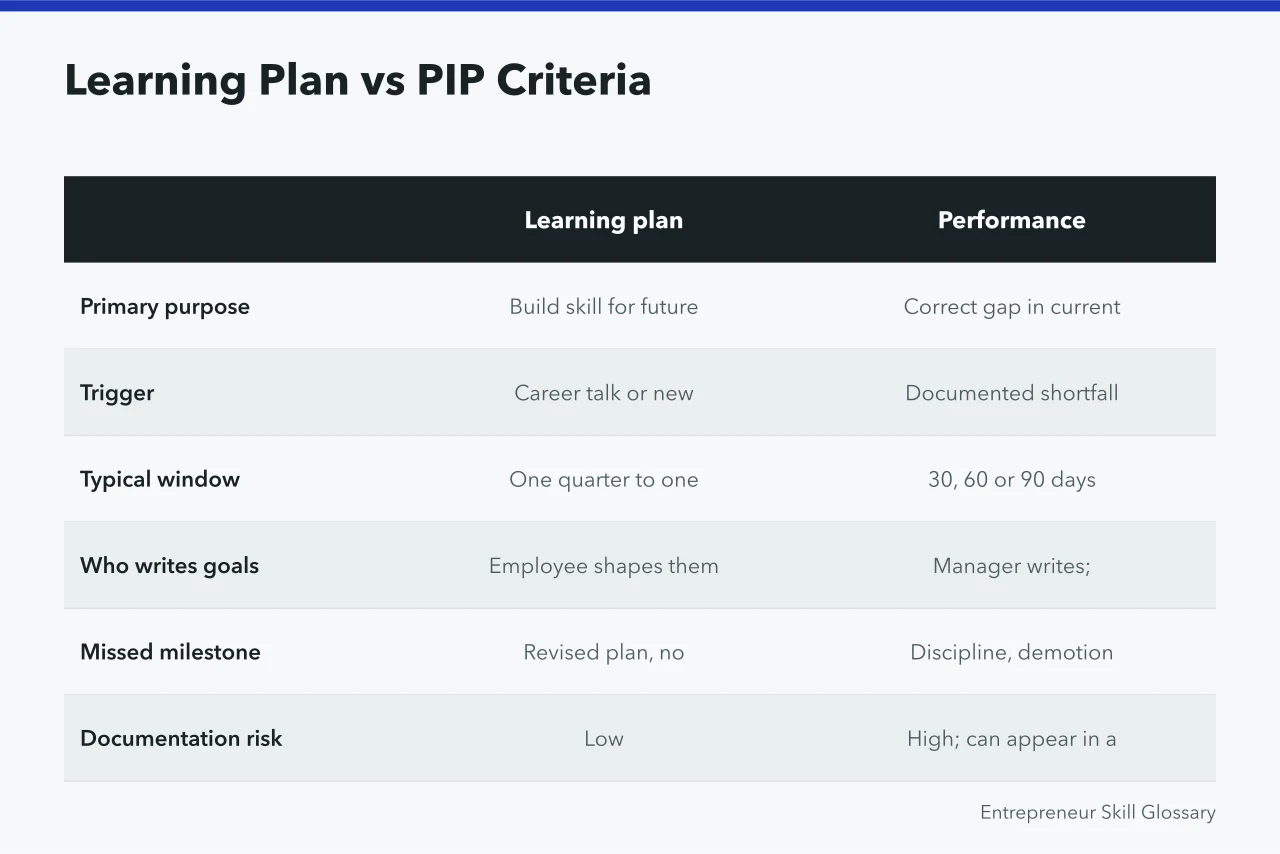
Learning plan
- Primary purpose
- Build skill for a future role
- Trigger
- Career conversation or new project
- Typical window
- One quarter to one year
- Who writes the goals
- Employee shapes them
- Consequence of a missed milestone
- Revised plan, no discipline
- Documentation risk
- Low
Performance improvement plan
- Primary purpose
- Correct a gap against the current role
- Trigger
- Documented shortfall or conduct issue
- Typical window
- 30, 60 or 90 days
- Who writes the goals
- Manager writes; employee signs
- Consequence of a missed milestone
- Discipline, demotion or exit
- Documentation risk
- High; can appear in a later claim
Neither column is a ranking. A PIP fits when the standard is clear and the employee can meet it with support. A learning plan fits when the standard is met and the question is what comes next.
Learning plan, option one
A learning plan answers a forward question: what does this person need to learn to take on more? It names a skill, a method for building it and a way to show progress. It can include paid training. The Department of Labor's fact sheet on hours worked and training time explains when attendance at a course counts as compensable hours.
Good learning plans attach the skill to a real deliverable. A junior analyst who wants to lead forecasting gets a plan that includes owning one forecast cycle with review. The plan does not threaten the employee's job. A shared definition helps teams agree on what a learning plan means in their own policy.
Performance improvement plan, option two
A PIP names the gap, the standard and the deadline. It usually includes weekly check-ins, written notes and a final review. Wikipedia's article that defines performance improvement plans describes them as tools for workers whose output or conduct falls below the requirements of the role.
The federal government separates growth from correction. The performance management cycle treats development plans and improvement plans as distinct steps. Private employers borrow the shape without the federal appeal rights.
A defensible PIP has three parts:
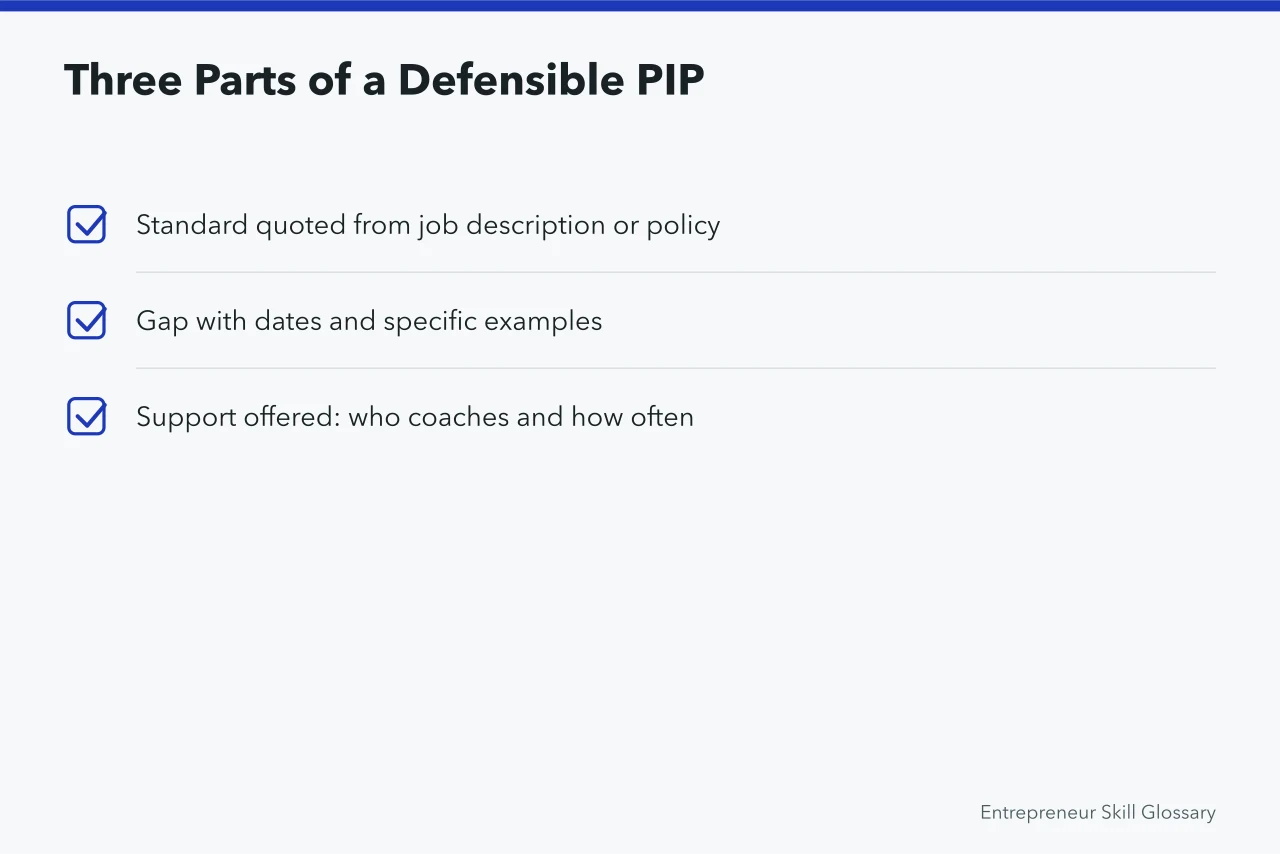
Do not use a PIP for a skill the role never required. Keep criteria job-related and verifiable.
Where each option wins
A learning plan wins when the employee meets the standard and the team needs a deeper skill. It also wins when a new project requires a skill nobody on the team has. The plan gives the employee a reason to stay and the manager a way to fill a gap without hiring.
A PIP wins when the gap is documented, the standard is clear and coaching can close it. It also wins when other employees carry the shortfall and the manager needs a deadline. A negotiation lens separates terms of art from phrases doing social work, which is a useful test for any plan label.
Example: one team, two documents
A support lead misses a monthly quality score three times. The score, the sample and the standard are in writing. That is a PIP case. Another lead meets every quality standard and asks to move into workforce planning. The skill gap is forecasting software. That is a learning plan case.
What neither plan solves
Both documents assume the manager can describe the gap in job-related terms and that the employee wants to stay. If either fails, neither plan works. An employee who has decided to leave will treat either document as paperwork.
A third shared limit is time. A 30-day PIP gives little room for real change. A one-year learning plan can outlast the project that inspired it. Neither plan fixes a pay problem or a manager who gives no feedback outside the review cycle.